
In the world of technical analysis, the idea that the “market discounts everything” stands as a foundational concept. It suggests that all available information—be it economic data, corporate earnings, or political events—is already reflected in asset prices. At TradeSmart, we embrace this principle to help traders streamline their strategies by focusing solely on price action and volume. Instead of chasing headlines, we turn to the charts, where every known variable is already factored in. Let’s explore how this powerful concept shapes market behaviour and technical trading.
What Does “Market Discounts Everything” Mean?
The phrase “market discounts everything” lies at the heart of technical analysis. It suggests that every piece of information—whether economic, political, or financial—is already reflected in current asset prices. From interest rate shifts and earnings reports to geopolitical events, the market is believed to have already priced in all known data. As traders at TradeSmart, we interpret this as the market’s way of processing and reacting to everything that could influence asset value.
This foundational concept draws from the Efficient Market Hypothesis (EMH) introduced by Eugene Fama in the 1970s. EMH claims that prices always reflect all available knowledge, meaning there’s no need to study news or company announcements separately—because those factors are already baked into the price.
Technical analysts embrace this principle by concentrating on price action and trading volume. Let’s say a stock suddenly jumps in price. Rather than looking for a press release or announcement, we analyse the chart—because that move likely reflects information already absorbed by market participants. At TradeSmart, we use this behaviour to identify profitable entry and exit points by focusing on patterns, indicators, and market trends.
In this view, past price behaviour holds predictive value. Since every bit of information is considered priced in, we don’t need to be distracted by news cycles. Instead, we fine-tune our strategies using tools like candlestick patterns and trendlines, confident that the price tells the full story.
How Does “Market Discounts Everything” Affect the Market Trend?
When we say “the market discounts everything,” we mean that stock prices already account for every known factor—whether it’s a GDP update or an upcoming earnings call. As such, traders at TradeSmart use price movement and volume as the primary indicators of market sentiment and direction.
This mindset allows us to rely less on interpreting news headlines and more on analysing price charts. A sharp movement—either up or down—generally signals that the market has processed new information. For example, if a stock drops suddenly, it likely reflects an earlier earnings miss or industry-wide concern that was already anticipated by the market.
Recognising historical price patterns becomes invaluable here. Since human reactions in the market often follow similar paths, price patterns such as double bottoms, flags, or trend reversals tend to repeat. At TradeSmart, we use these recurring trends to anticipate future market direction and strengthen our technical approach.
Why Does “Market Discounts Everything” Occur?
The reason this principle holds lies in how quickly markets react to information and in how traders behave collectively.
Markets continuously adjust to reflect all known information, often within seconds. When economic reports are released, or major events unfold, prices adapt immediately—sometimes even before the public fully digests the details. This is why, at TradeSmart, we often see market moves ahead of the actual headlines.
Another reason is herd behaviour. When investors react collectively—either buying or selling in response to perceived opportunity or risk—this group psychology embeds news into the market very quickly.
Technological advancements have only accelerated this process. High-frequency trading (HFT) algorithms, which now dominate major exchanges, can analyse data and execute trades in fractions of a second. These systems digest global news, earnings, and other metrics faster than any human can, making the market’s pricing mechanism even more efficient.
Emotion-driven trading also plays a role. In many cases, prices reflect fear, optimism, or panic more than hard data. For example, if market sentiment turns sour, prices can fall—even before the underlying reasons are fully understood. This collective emotional response further reinforces the idea that market prices already capture everything.
Who Made the Term “Market Discounts Everything?”
The concept of “market discounts everything” was first introduced by Charles Dow, the co-founder of Dow Jones & Company and the originator of Dow Theory. His groundbreaking work laid the foundation for modern technical analysis and continues to influence how we interpret price movements in financial markets today.
Dow believed that all publicly available information—including economic reports, corporate news, and even investor sentiment—is already reflected in a stock’s current price. According to this view, the market acts as a vast information-processing system, instantly adjusting prices to account for new data.
This principle has become a cornerstone of technical analysis. At TradeSmart, we apply this belief when analysing charts and patterns, trusting that price movements are a direct outcome of collective knowledge and expectations. Dow’s work continues to inform a wide array of trading strategies, highlighting how prices react to anticipated or emerging events.
How Does Technical Analysis Interpret “Market Discounts Everything?”
In technical analysis, the concept that “the market discounts everything” enables traders to focus on what truly matters: price and volume. At TradeSmart, we understand that sudden price spikes or dips often indicate the market has already absorbed fresh information.
For instance, if a company reports better-than-expected earnings, the stock price might rise immediately, not hours later. This reaction shows that traders anticipated good news or quickly acted on the announcement, reinforcing the notion that the market moves ahead of public understanding.
By studying historical price behaviour, traders can identify recurring patterns like head and shoulders, flag formations, or double tops. These formations help predict future price action, especially when combined with technical indicators.
Popular tools such as moving averages and the Relative Strength Index (RSI) allow us to assess trends and momentum. A moving average smooths out noise in price data, making it easier to spot direction, while RSI reveals overbought or oversold conditions—both based on past data already absorbed by the market.
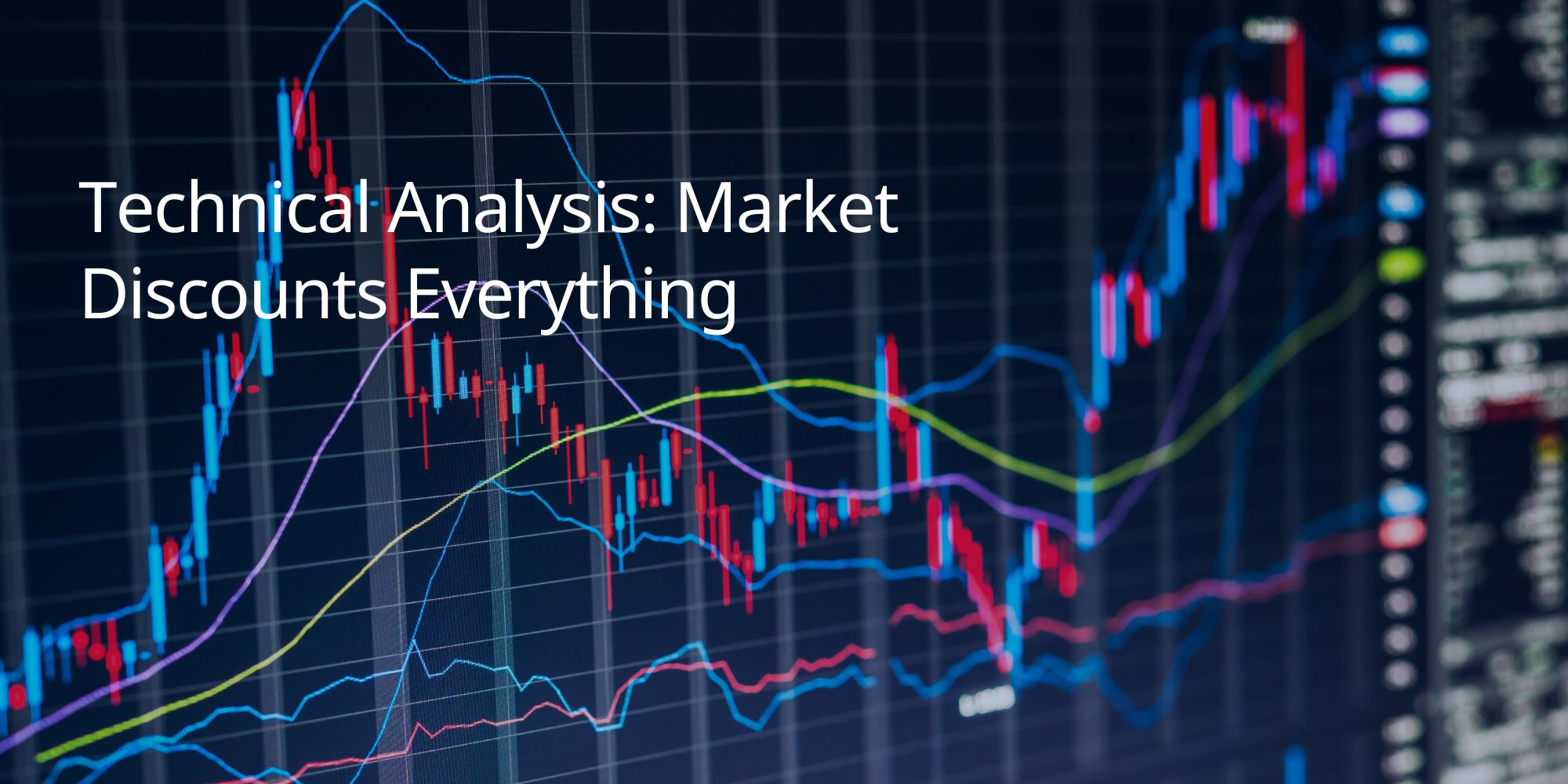
We also extensively use candlestick charts at TradeSmart, which visually capture market psychology in real-time. Each candlestick provides a snapshot of trader sentiment for a given session. By reading these formations, we gain deeper insight into likely price outcomes—without needing to dig through endless news.
How Do the Investors Think About “Market Discounts Everything?”
For many investors, especially those who use technical analysis, the idea that “the market discounts everything” provides a streamlined way to make decisions. Instead of spending time dissecting financial statements or economic news, they focus on price movements, believing that all information is already reflected in the chart.
Let’s say a company releases strong earnings. Rather than waiting for analysts to evaluate the numbers, investors watch the immediate price reaction. If the stock jumps, it’s assumed the market has already processed the positive results and is responding accordingly.
This approach, which we advocate at TradeSmart, allows traders to concentrate on price action and volume, rather than interpreting every data release or news article. A sudden surge in trading volume, for example, might signal the entry of institutional players or insider knowledge being acted upon—both already baked into the price.
Some investors are more cautious and prefer to use chart patterns—such as ascending triangles or bullish flags—alongside volume trends and momentum indicators. They use these tools to identify entry and exit points, confident that price reflects sentiment and fundamentals alike.
Although not every investor fully subscribes to this philosophy, most technical analysts consider it essential. It simplifies analysis, enabling us to focus on market trends and behavioural patterns—rather than chasing news that’s likely already priced in.
Conclusion
The principle that “the market discounts everything” empowers traders to interpret price movements without being overwhelmed by external noise. By assuming that all known information is already embedded in current prices, technical analysts can focus on identifying trends, patterns, and momentum using historical data. At TradeSmart, we equip you with the tools and insights needed to make the most of this principle—whether you’re reading candlestick formations or applying key indicators like RSI or moving averages. Understanding that prices reflect collective knowledge helps traders respond faster and smarter in today’s dynamic markets.